
Why can a stock fall after good earnings?
A beginner-friendly explanation of why stocks can fall even after strong revenue and profit, using expectations, guidance, valuation, and priced-in optimism.
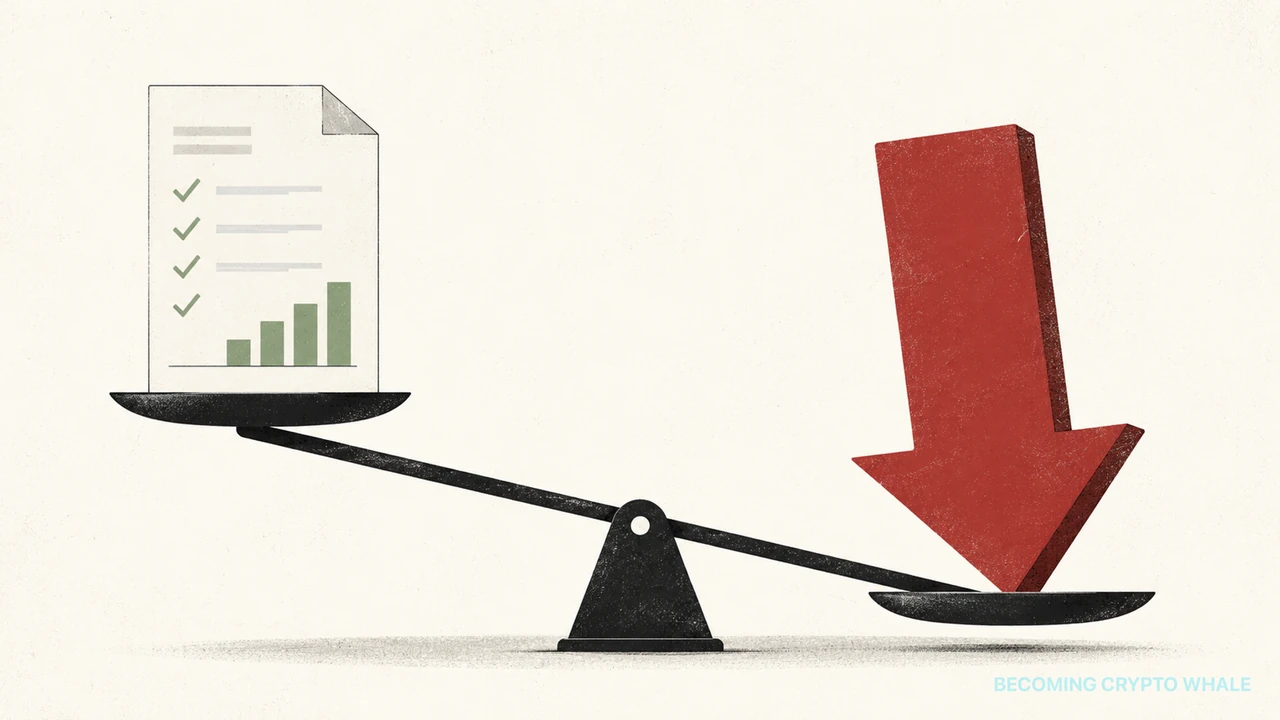
One of the most confusing moments for a beginner investor happens during earnings season.
A company reports higher revenue. Profit improves. Headlines even say the company beat expectations. Then the market opens, and the stock falls.
At first, this looks strange.
Shouldn't a stock go up when earnings are good?
Not always. The stock market does not react only to whether the numbers are good in isolation. It compares the new information with the expectations already built into the price.
The key idea is simple.
Stock prices often react more to how earnings change expectations than to the past earnings number itself.
So a stock can fall after good earnings. The problem may not be that the quarter was bad. The problem may be that the stock had already priced in an even better future.
A stock price is closer to an expectation sheet than a report card
An earnings report is a report card for the previous quarter. It shows revenue, operating income, net income, earnings per share, margins, and other important numbers.
Those numbers matter. But the stock price is not only about the past.
Investors also ask how much the company can earn in the future, how durable that profit might be, and whether today's price is too high for that future.
After earnings, the market usually compares three things.
First, did actual results beat market expectations?
Second, what did the company say about the next quarter or the full year?
Third, how much had the stock already risen before the announcement?
For a stock to rise comfortably, all three often need to support the story. If actual earnings are strong but guidance is weak, or if the price had already run too far, a good report can still lead to a lower stock price.
Beating estimates can still be not enough
You will often see the phrase earnings surprise. It usually means the company reported better results than analyst consensus.
But consensus is not the only expectation in the market.
Imagine analysts expected revenue of 100 and the company reported 105. On the surface, that is a beat. But if the stock had already rallied because investors hoped for 110, then 105 can be good and disappointing at the same time.
Consensus is the visible number. The stock price also contains positioning, recent momentum, options expectations, and investors' unofficial hopes.
That is why the better question is not only, "Did the company beat estimates?"
The better question is:
Was the news better than what the price already expected?
If the answer is no, the stock can fall even after a good quarter.
Weak guidance can overpower strong past results
Guidance is one of the most important parts of an earnings release. It is management's outlook for the next quarter, the full year, or key metrics such as revenue, margins, and expenses.
Stocks try to discount future earnings. If last quarter was strong but management signals that the next quarter may be weaker than expected, investors can quickly lower their future estimates.
NVIDIA's fiscal 2027 first-quarter results show why this matters. On May 20, 2026, NVIDIA reported revenue of $81.6 billion, up 85% from a year earlier, and Data Center revenue of $75.2 billion, up 92% year over year. The company also guided for fiscal second-quarter revenue of $91.0 billion, plus or minus 2%. The official NVIDIA release shows that investors had to look at both the completed quarter and the next-quarter outlook.
If a different company reports strong historical results but lowers its future outlook, the market may read it this way:
"Last quarter was good, but can this pace continue?"
That question can matter more than the headline earnings number.
High valuation makes small disappointments look large
Valuation is another reason good earnings can fail to lift a stock.
Valuation simply asks how expensive a stock is relative to earnings, sales, cash flow, or future growth. A high valuation is not automatically bad. It can mean the market expects strong growth.
But the higher the expectation, the smaller the margin for disappointment.
Growth stocks, AI stocks, semiconductor stocks, and other popular themes often need more than a good quarter. The market may demand fast revenue growth, stable margins, strong guidance, and management commentary that supports the long-term story.
If one part is weak, the stock can fall. The company may still be excellent, but the price may have been ahead of the evidence.
A stock that already rose can face profit-taking
Sometimes the answer is even simpler. The stock ran up before earnings, and investors sold after the event.
This does not always mean the business got worse. It can mean the market bought the expectation first and then took profits once the news arrived.
This is why traders often say, "Buy the rumor, sell the news."
The phrase does not explain every case, but it appears often around earnings announcements. If a stock surged before the report, even good news can trigger short-term selling.
Beginners should separate two ideas.
A falling stock price does not automatically mean the earnings were bad. Good earnings also do not guarantee an immediate price increase.
The reaction comes from the gap between expectations and price.
Interest rates and market mood matter too
Even strong company results can be overwhelmed by the broader market environment.
Growth stocks are especially sensitive to interest rates. When rates rise or rate-cut hopes fade, future earnings are discounted more heavily. That makes high valuations harder to defend.
The April 2026 FOMC minutes noted that market participants expected little change in the federal funds rate this year and that expected rate cuts had shifted later. The same minutes also said technology-sector gains were supported by strong earnings expectations. The Federal Reserve minutes are a useful reminder that earnings and rate expectations move stock prices together.
This does not mean good earnings are unimportant. It means good earnings are judged inside a larger setting: rates, inflation, oil prices, growth expectations, and valuation.
What should beginners check after earnings?
If a stock falls after reporting good earnings, do not jump straight to "bad news." Work through a checklist.
First, did revenue and profit beat expectations?
Second, did the company raise or lower guidance?
Third, did margins hold up?
Fourth, had the stock already rallied before the release?
Fifth, what did management say about demand, inventory, pricing, costs, and competition?
This process helps turn a confusing headline into a clearer explanation.
The simple takeaway
Most cases can be summarized in one sentence.
The company may have delivered good numbers, but the stock may have expected even better numbers.
The stock market checks past results, but it prices future expectations.
For beginners, the better habit is to ask:
"Was this report better than what the price already assumed?"
"Did the future outlook improve?"
"Can the current valuation still make sense?"
Once you ask those questions, a stock falling after good earnings no longer looks irrational. Stocks are about numbers, but the standard used to judge those numbers is always expectations versus price.