
NVIDIA Earnings Are the Midterm Exam for the AI Rally
NVIDIA's May 20, 2026 earnings report after the U.S. market close is not just one company's quarter. It is a test of AI infrastructure spending, semiconductor valuations, and Big Tech CAPEX.
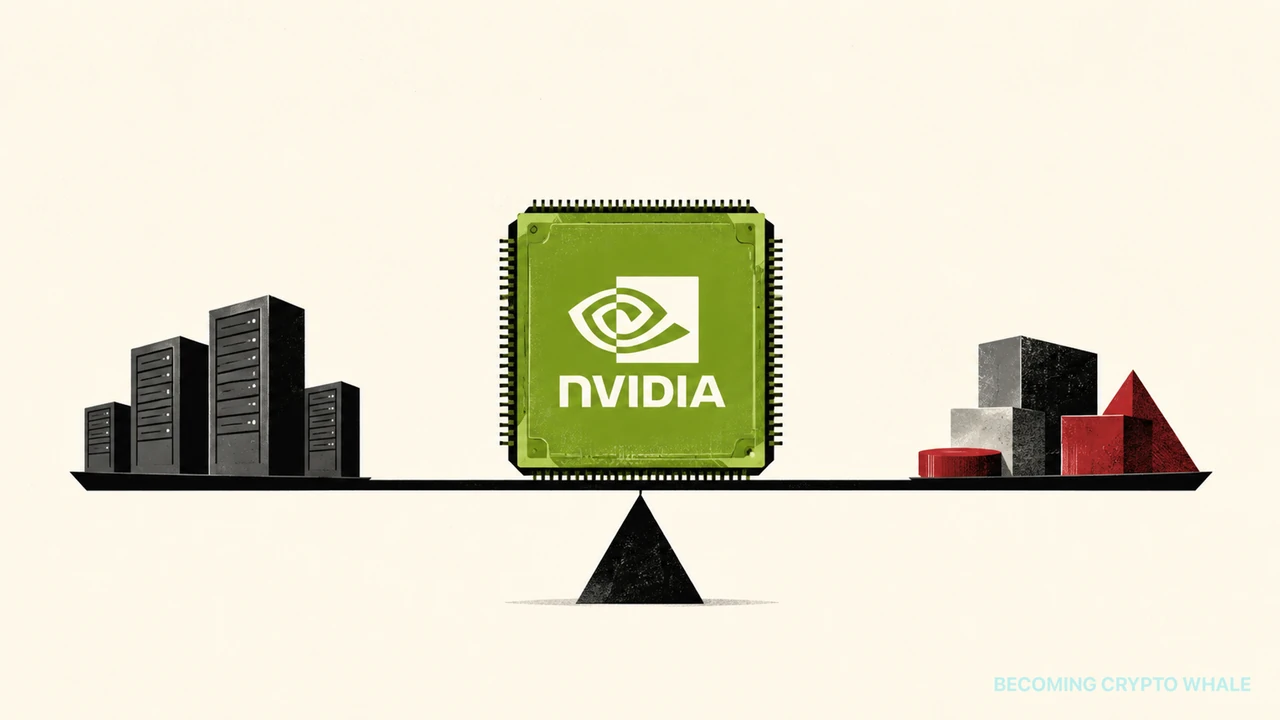
After the U.S. market close on May 20, 2026, investors will get NVIDIA's first-quarter fiscal 2027 results.
This is not just a question of whether NVIDIA had a good quarter. NVIDIA has become the price tag for the entire AI infrastructure cycle.
The report is the cleanest way for investors to test whether Microsoft, Amazon, Google, Meta, and other large customers are still spending aggressively on AI data centers, whether that spending is turning into revenue and profit, and whether the market can keep supporting high valuations for AI growth stocks.
The core question is simple.
Is the AI rally still being justified by earnings?
Why one company can move the whole market
NVIDIA has already printed extraordinary numbers. In the fourth quarter of fiscal 2026, revenue reached $68.1 billion, with data center revenue alone at $62.3 billion. Full-year revenue was $215.9 billion, and full-year data center revenue was $193.7 billion.
The more important number is the hurdle for this quarter. NVIDIA guided for first-quarter fiscal 2027 revenue of $78.0 billion, plus or minus 2%. The market already knows AI demand is strong. The test is whether demand is strong enough to beat a very high bar.
Options markets show the same tension. Reuters reported that traders were pricing in roughly a $355 billion swing in NVIDIA's market value after the results. That is larger than the standalone market value of many major S&P 500 companies.
This volatility is not only about NVIDIA. If the stock rises sharply, AI semiconductors, memory, power infrastructure, data centers, and cloud-related stocks can all benefit. If the results disappoint, the market can quickly move from “AI is growing” to “AI spending may be too expensive.”
The first number to watch: data center revenue
NVIDIA's core business is no longer gaming GPUs. It is AI servers.
That makes data center revenue the first number to watch. A strong number would not merely mean more chips were sold. It would mean hyperscalers and AI companies are still rushing to secure compute infrastructure.
Investors should look for how quickly Blackwell demand is converting into revenue, whether supply bottlenecks are easing, and whether large customer orders remain durable.
If data center revenue misses expectations, the market may not conclude that AI demand has disappeared. But it may start questioning the speed of AI infrastructure spending. Stocks react not only to the level of demand, but to changes in its pace.
Margins and guidance are the real exam
Strong AI chip demand is not enough if margins begin to weaken.
NVIDIA has been valued as a dominant company not only because revenue has grown quickly, but because pricing power and margins have stayed exceptional. If revenue is strong but margins fall, investors will look again at supply-chain costs, product transitions, inventory adjustments, and U.S. export restrictions.
Revenue is a signal of growth. Margin is a signal of control. The AI rally needs both.
Guidance may matter even more. Stocks respond more to future numbers than to past quarters. A good backward-looking report can still disappoint if the next-quarter outlook is not strong enough.
Investors will listen for whether AI server demand is expanding from training into inference, whether the product roadmap after Blackwell is pulling real customer spending forward, and whether data center customers are still increasing budgets.
China risk and Big Tech CAPEX
NVIDIA said its first-quarter fiscal 2027 outlook did not assume any China data center compute revenue. That may be a conservative assumption, but it also shows that U.S. export restrictions and Chinese domestic chip alternatives remain part of the growth story.
The question is not only how much China contributes. The real question is whether demand from the U.S., the Middle East, Europe, and Asian cloud customers can offset that gap.
NVIDIA's results are also tied directly to customer investment plans. If Big Tech keeps raising AI data center spending, NVIDIA's revenue can continue to expand. But if investors begin to think AI infrastructure spending is growing faster than the returns from AI products, the same numbers can be interpreted more cautiously.
This is not a debate about whether AI is useful. The market is asking a more specific question.
Can the money going into AI infrastructure produce enough return?
Investor checklist
This is not a buy-or-sell recommendation. The point is to read the structure before reacting to the stock price.
1. How far did data center revenue exceed guidance and expectations?
Data center is the core. If it weakens, the wider AI trade can weaken with it.
2. What did the Blackwell transition do to revenue and margins?
New product transitions can create growth, but they can also create supply and cost noise.
3. Is next-quarter guidance strong enough?
The market is buying the future. Weak guidance can overshadow a good past quarter.
4. Are other regions offsetting the China gap?
Investors should watch whether U.S., Middle Eastern, European, and Asian cloud demand can absorb China-related restrictions.
5. Has management's tone on AI CAPEX changed?
It is not enough to say demand is strong. Investors need evidence of customer budget durability, supply visibility, and inference-driven growth.
Conclusion: a great company is not always a cheap stock
NVIDIA is central to the AI infrastructure era. That is difficult to dispute. But a great company and a good entry price are not the same thing.
When expectations are very high, even good results can send a stock lower. The market cares less about whether the number is good in isolation and more about whether it beats what was already priced in.
That is why the real question is not simple.
Can NVIDIA justify the AI rally one more time?
The answer could shape not only NVIDIA's stock, but the direction of AI semiconductors and growth stocks in 2026.