
NVIDIA Passed. Now Rates Are the Market's Test.
NVIDIA proved that AI demand is still strong with $81.6 billion of revenue and $75.2 billion of Data Center revenue. But FOMC minutes and long-term yields show that the market's next test is not earnings. It is the discount rate.
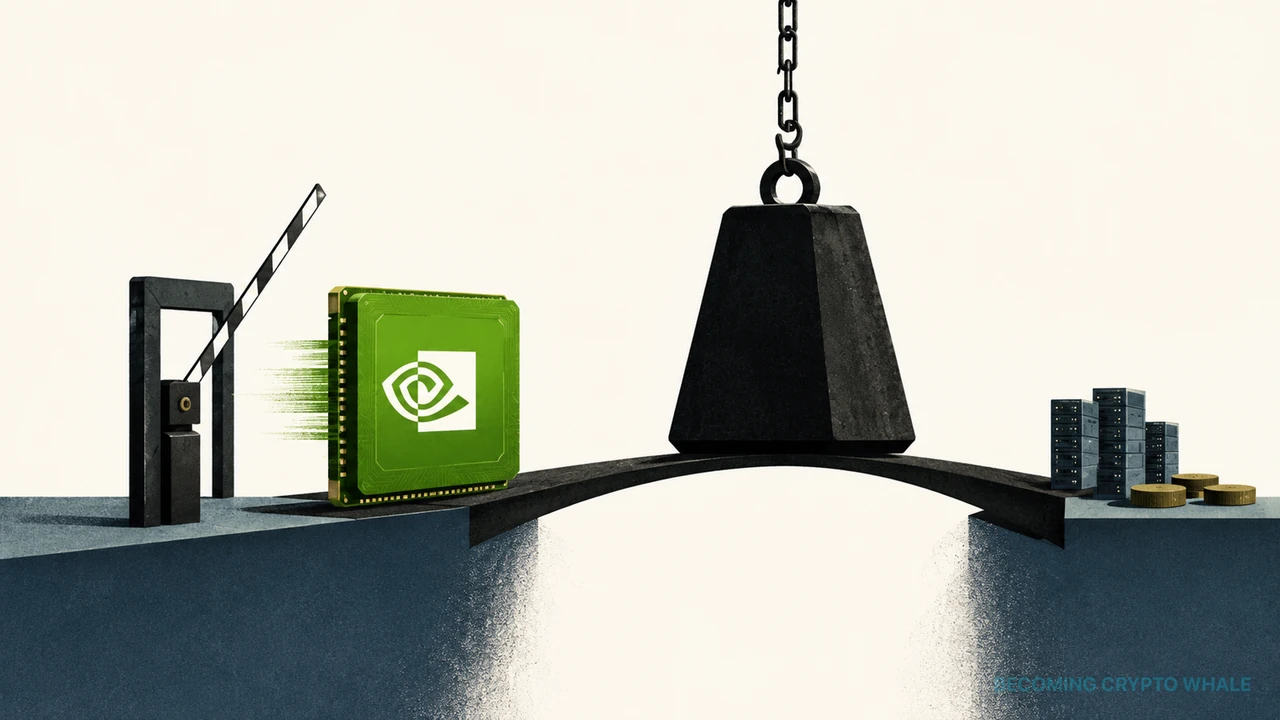
This article is based on information available as of 00:00 UTC on May 21, 2026. NVIDIA released its results after the U.S. market close on May 20, 2026, the same day the Federal Reserve released minutes from its April meeting.
NVIDIA passed the test.
First-quarter fiscal 2027 revenue was $81.6 billion, up 85% from a year earlier and 20% from the prior quarter. Data Center revenue was $75.2 billion, up 92% year over year and 21% sequentially. GAAP gross margin was 74.9%, while non-GAAP gross margin was 75.0%. The company guided second-quarter revenue to $91.0 billion, plus or minus 2%.
Those numbers leave little room for an easy bearish interpretation. AI demand is still strong, data center spending is still moving, and NVIDIA is still showing both scale and pricing power. The company also announced an additional $80.0 billion share repurchase authorization and a larger quarterly dividend.
But the market's question has already moved forward.
NVIDIA passed. Can the broader market pass the test of higher rates?
What NVIDIA's results proved
The most important number was Data Center revenue. NVIDIA's core business is no longer gaming GPUs. It is AI data center infrastructure.
Revenue of $75.2 billion in Data Center does not simply mean that more chips were sold. It means large technology companies, cloud providers, and AI infrastructure buyers are still purchasing compute aggressively. Training, inference, agentic AI, and enterprise AI workloads are still translating into data center demand.
Margins matter as much as revenue. A high-growth company can impress with top-line expansion, but maintaining gross margin around 75% while scaling this quickly is a different signal. It says demand is strong and the company still has leverage in product mix, supply, and pricing.
The next-quarter guide also supported the growth story. A $91.0 billion revenue outlook suggests that the AI infrastructure cycle is not a one-quarter event. But there is a caveat: NVIDIA said its outlook does not assume any China Data Center compute revenue. China risk has not disappeared. Strong demand elsewhere is covering it for now.
The simple conclusion is that the AI-demand slowdown argument looks weaker after these numbers.
Why rates now matter more
Good earnings can solve a company problem. They do not automatically solve a market problem.
The FOMC minutes released on the same day sent a different message. At its April 28-29 meeting, the Fed kept the federal funds target range at 3.5% to 3.75%. The minutes described inflation as elevated and pointed to energy prices and geopolitical uncertainty as factors complicating the outlook.
The direction matters. The Fed did not give the market a clean path toward cuts. It emphasized both upside inflation risk and downside labor-market risk. Some officials were uncomfortable with language that suggested an easing bias, and the minutes discussed the possibility that inflation pressures could become more broadly embedded.
That is not an easy backdrop for risk assets, even when earnings are strong. Growth stocks are valued by discounting future cash flows. When long-term yields rise, the discount rate rises. The same NVIDIA story can receive a different valuation when the 10-year Treasury yield is below 4% than when it is above 4.6%.
NVIDIA passed the earnings exam. The market still has to pass the discount-rate exam.
The pressure from Treasury yields
U.S. stocks received help on May 20 as long-term yields eased. AP reported that the 10-year Treasury yield fell to 4.57% from 4.67% late the previous day, supporting a rebound in equities. One day earlier, the 10-year and 30-year Treasury yields had touched 52-week highs of 4.687% and 5.197%.
These numbers matter because the market already knows AI growth is real. The next question is what discount rate should be applied to that growth.
Lower yields can support higher growth-stock multiples. Higher yields make investors ask whether even excellent earnings have already been priced too aggressively.
That is why the market cannot simply relax after a strong NVIDIA print. AI may not be the problem. The price investors are willing to pay for AI may be the problem.
Bitcoin is taking the same exam
This structure is not limited to equities. Bitcoin and crypto markets are also influenced by liquidity and real rates.
Bitcoin has its own supply dynamics, ETF flows, long-term holder behavior, and post-halving structure. It is not identical to a technology stock. But once it trades as a risk asset, it cannot be fully detached from long-term yields and dollar liquidity.
Strong AI earnings can support risk appetite. But if long-term yields continue to rise, investors compare higher available bond yields with volatile risk assets. In that setting, Bitcoin can become more sensitive to liquidity conditions than to growth narratives.
The question is broader than whether NVIDIA is good or bad.
Can a strong growth story beat a high-rate environment?
Investor checklist
First, watch the 10-year and 30-year Treasury yields. Strong NVIDIA earnings may not be enough if long yields return to their highs.
Second, watch the Fed's language. Markets want to buy rate-cut optionality, but risk assets can reprice quickly if the Fed sounds more concerned about sticky inflation.
Third, watch whether the semiconductor rally broadens beyond NVIDIA. Memory, power infrastructure, data centers, and cloud stocks need to confirm the same story.
Fourth, watch the quality of AI CAPEX. It is not enough for Big Tech to keep spending. That spending has to become revenue, productivity, and margin.
Fifth, watch Bitcoin's reaction. If Bitcoin cannot respond to strong AI earnings, the market may be focusing more on liquidity than on growth.
Conclusion
NVIDIA proved that AI demand remains strong. Revenue, Data Center sales, margins, and guidance all supported the core AI infrastructure story.
But the market's exam has changed.
Yesterday's question was whether AI earnings were real. Today's question is whether investors can pay the same price for those earnings in a high-rate world.
For the AI rally to continue, NVIDIA alone is not enough. Treasury yields need to calm down, the Fed needs to avoid turning more hawkish, and Big Tech CAPEX needs to keep converting into real economic returns.
NVIDIA passed. Now the market has to pass rates.