
Strait of Hormuz Risk Check 2026: A Practical Framework for Reading Oil, Gold, Stocks, and Bitcoin
A practical 2026 guide to understanding Strait of Hormuz risk through oil, gold, stocks, bitcoin, inflation, and liquidity instead of sensational headlines.
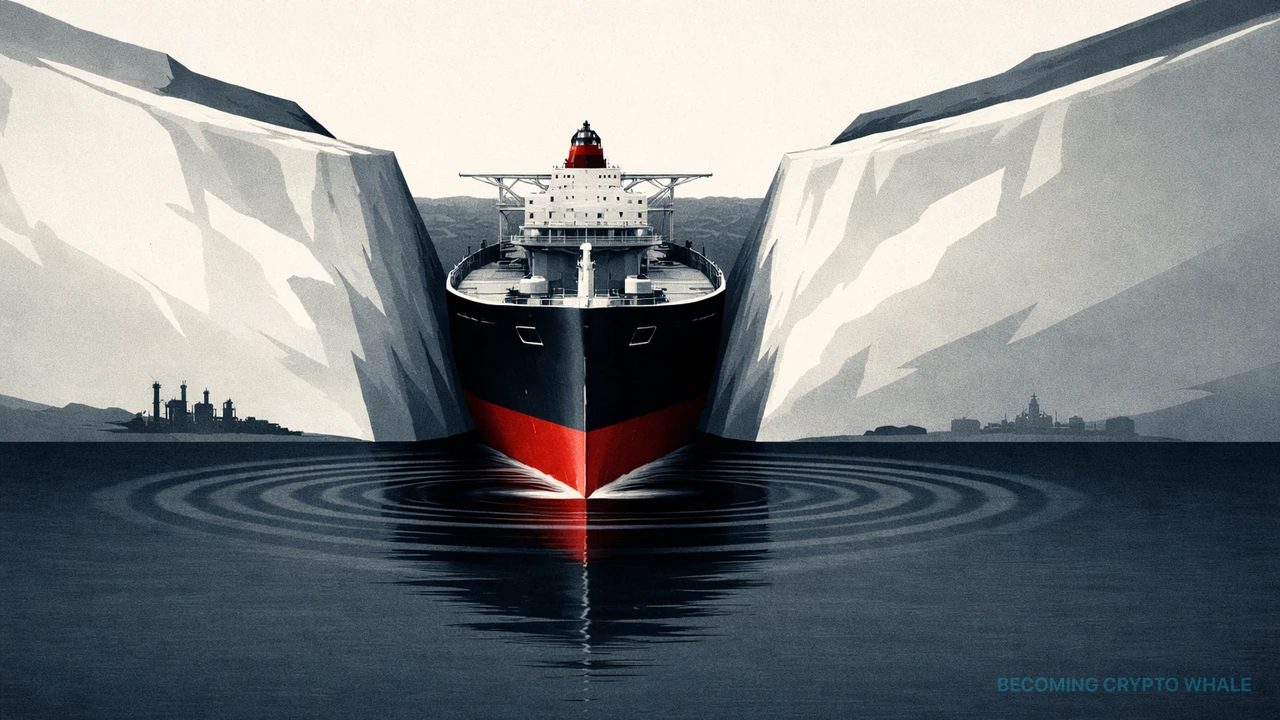
On March 4, 2026, the U.S. Maritime Administration (MARAD) issued an advisory for commercial vessels transiting the Strait of Hormuz and nearby waters. Then on March 13, 2026, the U.S. Energy Information Administration (EIA) explained that even without a universally recognized "full closure," threats, insurance cancellations, avoidance by shipowners, and partial production shut-ins could sharply reduce tanker traffic.
That means investors should not fixate on whether a legal closure has been declared. What matters more is how much real energy flow is delayed, how long the disruption lasts, and how that shock spills over into inflation, rates, and liquidity.
Why the Strait of Hormuz matters
According to the EIA, about 20.9 million barrels per day moved through the Strait of Hormuz in the first half of 2025, roughly 20% of global petroleum liquids consumption. More than 20% of global LNG trade also passed through this corridor.
The bigger problem is that alternative routes are limited. Saudi and UAE bypass pipelines can handle roughly 4.7 million barrels per day, far below total Hormuz volumes.
In other words, markets can still swing hard even without a textbook full closure if one or more of the following appear:
- Transit delays
- A surge in war-risk insurance costs
- Avoidance by shipowners and charterers
- Temporary production disruptions by exporters
- Wider refining margins and freight costs
Markets price bottlenecks before they price legal language.
How the shock usually travels through markets
When Hormuz risk rises, oil is usually the first market to react. But investors should focus more on the second-order transmission path than on oil alone.
- Oil prices rise
- Transport and input-cost pressure expands
- Inflation expectations re-accelerate
- Rate volatility increases or easing expectations fade
- Valuation pressure hits stocks and crypto
The point is not simple fear. The real question is whether the energy shock starts tightening both the real economy and financial conditions at the same time.
How to read each asset class
Gold and the dollar: likely first refuges
In the initial phase of a geopolitical shock, gold and the U.S. dollar are often relatively preferred.
- Gold is the traditional crisis hedge.
- The dollar remains the center of global settlement and liquidity.
That said, they do not always lead for the same reason or with the same duration. If growth fears dominate, gold may outperform. If dollar liquidity stress rises, the dollar may dominate.
Stocks: pressure from both costs and discount rates
Equities can be squeezed from two directions at once.
- Higher energy and freight costs can damage margins.
- Re-accelerating inflation can lift discount-rate pressure.
Markets with high energy import dependence are usually more sensitive. In import-heavy economies like South Korea, sector selection may matter more than broad index exposure.
Bitcoin: risk asset first, then a possible re-divergence
It is too simplistic to assume that war risk automatically makes bitcoin rally.
In practice, the reaction often comes in two stages:
- Initial shock: if leverage is cut and broad risk-off hits, bitcoin can sell off alongside the Nasdaq.
- Second-stage divergence: later, depending on central bank responses, the dollar, real yields, and bitcoin's relative strength versus gold, the digital-gold narrative can regain traction.
In other words, bitcoin is not an automatic safe haven. It is closer to an asset whose role changes with the liquidity regime and the macro narrative.
The most important step is separating scenarios
| Scenario | Oil | Gold / Dollar | Stocks | Bitcoin |
|---|---|---|---|---|
| Short-lived tension followed by easing | Possible spike, then retracement | Safe-haven premium fades | More room for a rebound | Beta rebound possible |
| Prolonged transit disruption | Can stay elevated | Relative strength can persist | Cost pressure lingers | Weak early, then re-diverges with liquidity |
| Production disruption + re-accelerating inflation | Risk of another leg higher | Strong upside case | Most vulnerable | High volatility, hard to call direction |
The purpose of this table is not prediction. It is preparation. When you become certain in only one direction, volatility usually humbles you.
BCW response framework
In this kind of tape, position structure matters more than headline interpretation.
1) Cut leverage first
In macro headline markets, expanding volatility is often more dangerous than being slightly wrong on direction. Smaller size and a wider safety margin come first. Use Whale Tools to check your liquidation level before asking whether the thesis is attractive.
2) Write down both the thesis and the invalidation
It is not enough to record only why you entered. You also need to write what would prove the idea wrong inside Whale Journal. Geopolitical markets amplify confirmation bias very quickly.
3) Watch second-order indicators, not just headlines
These four signals matter far more:
- Is oil making a one-day spike or starting a real trend change?
- Are the dollar and real yields rising together?
- Is market breadth recovering even if stocks bounce?
- Is bitcoin regaining relative strength versus the Nasdaq?
News tells you what happened. Your portfolio should be managed through second-order indicators.
Conclusion
In Strait of Hormuz risk, investors should not focus on the word closure by itself. The more important question is how much energy flow is actually impaired, how long the shock lasts, and whether the fallout spreads into rates and liquidity.
Gold, the dollar, stocks, and bitcoin can all react to the same headline on different time horizons. If you understand that difference, you can prepare by scenario instead of trading fear.
In crisis markets, survival matters before return. Only positions that stay alive get to meet the next opportunity.
Editorial note: This article was written from public information available as of March 19, 2026. Geopolitical conditions and shipping flows can change quickly.
This article is for educational purposes only and is not investment advice.