
Why a yen carry-trade unwind can shake U.S. stocks and crypto
A beginner-friendly explanation of how Japan's interest rates, the yen, and carry trades can affect global stocks, Bitcoin, and other risk assets.
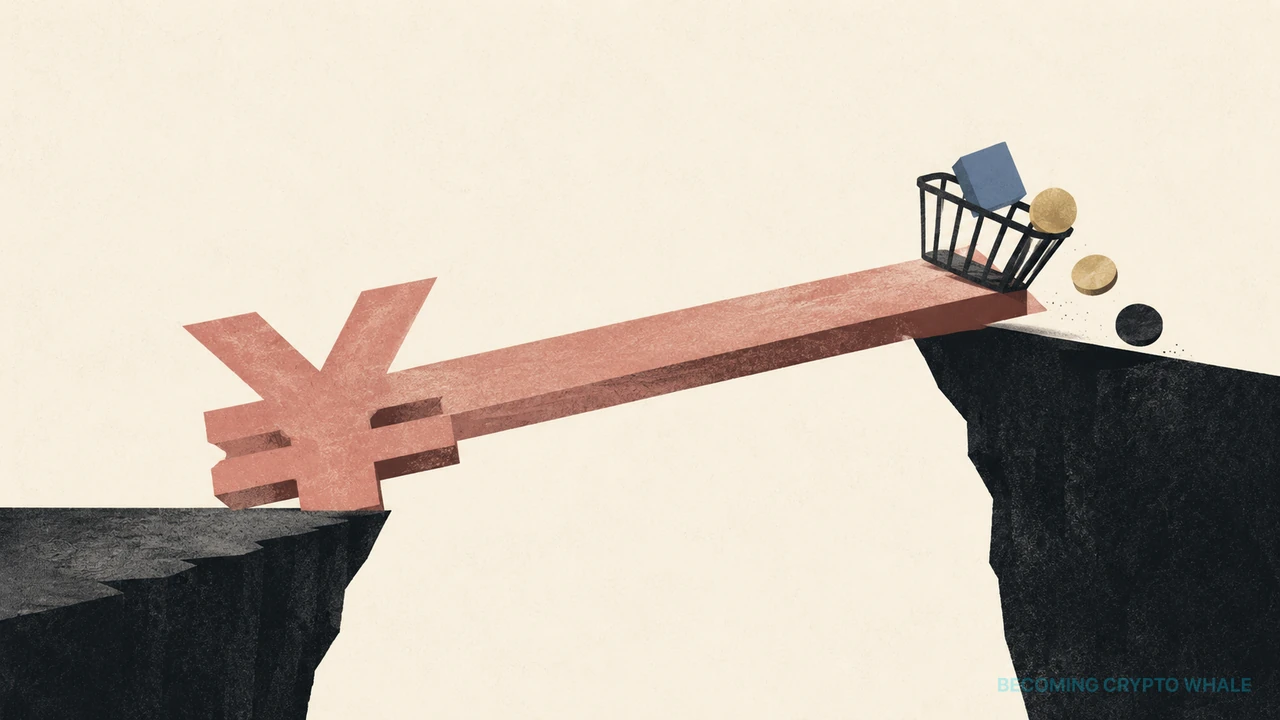
The yen carry trade sounds complicated, but the basic idea is simple.
Investors borrow in yen when Japanese interest rates are low, then use that money to buy assets that may offer higher returns elsewhere. They borrow cheap money and try to earn more with it.
The problem is that when this trade becomes large, it stops being only a Japan story.
If yen funding becomes more expensive, leveraged money in global risk assets can shrink.
That is why Japan's rates and the yen can affect U.S. stocks, emerging markets, Bitcoin, and altcoins.
Carry trades are about interest-rate differences
Imagine Japanese rates are low and U.S. rates are higher. An investor borrows yen, converts it, and buys dollar assets. If the asset rises and the currency move is favorable, the trade can benefit from both return and rate difference.
This works best when markets are calm. A weak yen, low volatility, and rising risk assets make the trade comfortable.
But if conditions change, the trade can reverse. If Japanese yields rise, the yen strengthens suddenly, or volatility jumps, investors may cut positions. To repay yen borrowing, they may sell risk assets and buy yen.
That reversal is called an unwind.
Why Japanese rates matter
Japan has been a major source of low-cost funding for a long time. That made the yen useful as a funding currency. If that environment changes, investors have to recalculate.
Higher Japanese government bond yields raise the cost of yen funding. BOJ signals about rate hikes or bond-purchase tapering can make investors reprice carry-trade risk.
Reuters has reported both large yen-buying intervention by Japanese authorities and market attention around the Bank of Japan's bond-buying plans. These are not isolated domestic details. They affect how global leverage is priced.
The key point is that the yen is not just a currency chart. It is connected to the cost of global leverage.
Why U.S. stocks and crypto can move
When carry trades unwind, investors often reduce risk. Stocks, emerging-market assets, high-yield credit, and crypto can all face pressure.
Bitcoin has its own long-term story, but in the short term it often reacts to liquidity, rates, the dollar, and leverage. If the yen strengthens sharply, traders may read it as a sign that carry funding is being reduced.
The market may think:
Carry money is shrinking.
Leveraged positions may be forced to close.
Investors may sell risk assets to raise cash.
When that interpretation spreads, even strong company earnings may not be enough to stabilize the whole market.
What beginners should watch
First, watch USD/JPY. A rapid yen rally can raise unwind fears.
Second, watch Japanese government bond yields, especially long maturities such as 10-year, 30-year, and 40-year yields.
Third, watch BOJ language: rate hikes, bond purchases, inflation, and wage growth.
Fourth, watch global volatility. If the yen, U.S. yields, the dollar, VIX, and Bitcoin volatility all move together, the story may be larger than Japan alone.
Fifth, watch whether risk assets fall together. U.S. tech, emerging markets, and crypto weakening at the same time can signal a liquidity event.
Do not overuse the explanation
The yen carry trade is not the reason for every market drop. Stocks also respond to earnings, growth, rates, and valuation. Crypto responds to ETF flows, regulation, leverage, and supply.
But carry trades show the hidden funding structure behind markets. Most of the time they are quiet. When they unwind, many assets can move at once.
A simple way to remember it:
The yen is not only Japan's currency. It can also be cheap borrowed money inside global risk assets.
If that cheap money becomes expensive, markets reprice.
The takeaway
The yen carry trade looks like a foreign-exchange strategy, but the core idea is cheap funding versus risky assets.
When the yen is weak and Japanese rates are low, the trade can support risk-taking. When the yen strengthens and Japanese yields rise, leveraged money can retreat.
That is why U.S. stock and crypto investors should not ignore Japan. The next volatility shock may start in Tokyo, not New York.